African films are reaching audiences. Why is distribution still the weak link?
A new GIZ–Afreximbank/CANEX study by Dalberg examines six film markets and finds that the missing investment often comes after the camera stops rolling: distribution, marketing, access and audience data.
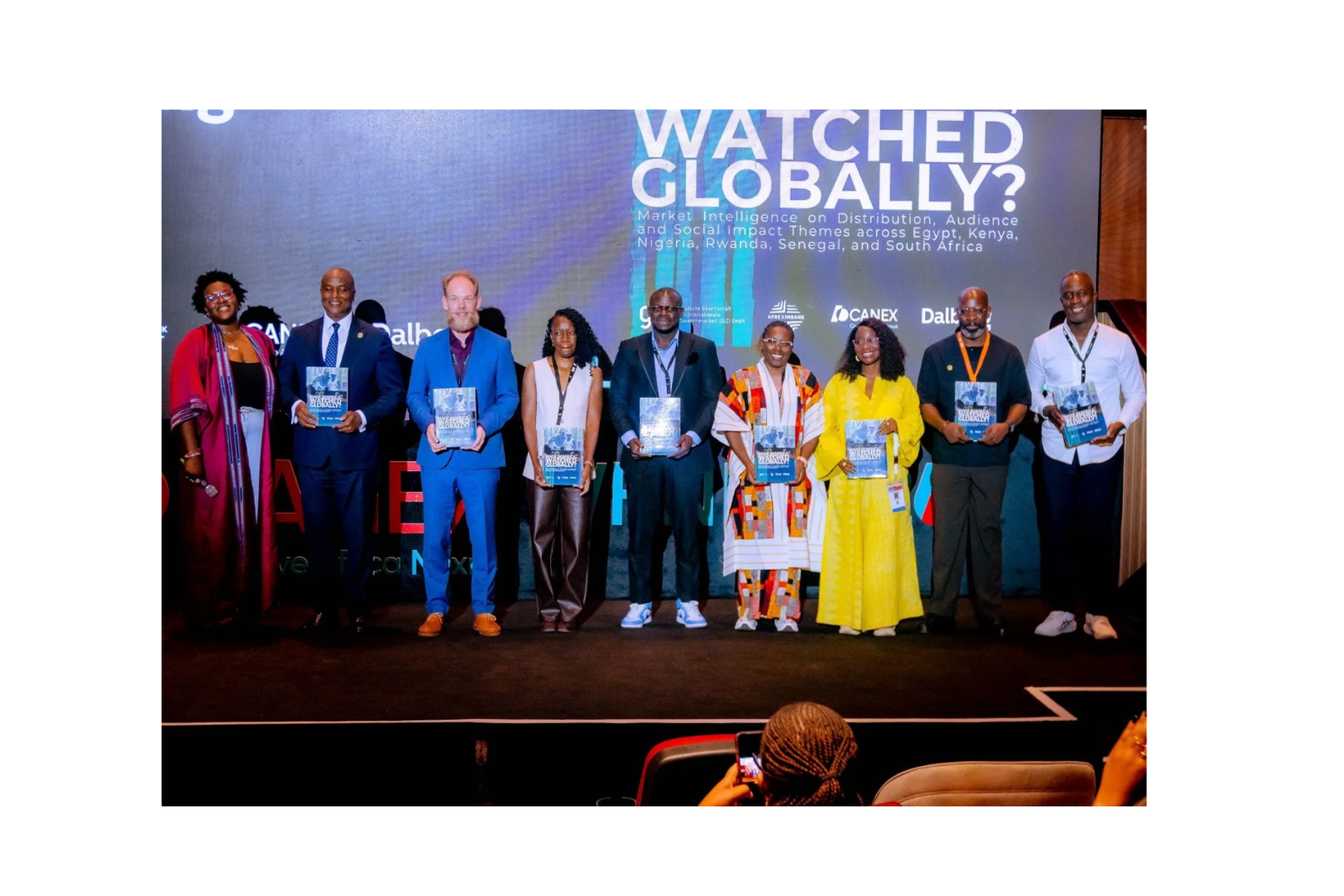
African film production has grown, international recognition is more visible, and online viewing is expanding. Yet the relationship between those gains and sustainable revenue for film businesses remains fragile. Made in Africa, Watched Globally?, a study commissioned by GIZ and Afreximbank through CANEX and produced by Dalberg, locates a significant part of the problem in distribution, not simply in the ability to make films.
Unveiled at CANEX WKND 2026 in Lagos, the study covers Egypt, Kenya, Nigeria, Rwanda, Senegal and South Africa. Its evidence includes 91 stakeholder interviews, a survey of 1,630 viewers, five case studies and secondary market research. The authors caution that the audience sample is indicative rather than nationally representative, and that film industry data remain fragmented.
A growing screen market does not mean a growing audience for every film
The research cites a projection of $5.2 billion in combined pay-TV and streaming revenues across the six markets by 2030. That figure measures the wider audiovisual distribution market, not the box office of African films or the income of African producers.
Nigeria illustrates the distinction between value and reach. The report says theatrical box-office revenue increased 34.7% to ₦15.6 billion in 2025, while admissions grew only around 5% and remained below their 2021 peak. Over several years, ticket-price inflation has contributed heavily to rising takings. Higher gross receipts therefore need not signal that cinema is becoming affordable to a broader audience.
In the same market, more than 90% of films classified each year are reported not to reach cinema screens. South African local titles accounted for around 3% of cinema releases and under 1% of box-office revenue in 2023, according to data cited in the study. Those figures describe different markets and periods, but they point in the same direction: production output and theatrical access are not moving together.
The infrastructure is uneven and concentrated
Across much of Africa, the report estimates roughly one cinema screen for every 787,000 people. Kenya has fewer than 50 screens nationwide, with more than three quarters located in Nairobi. Rwanda entered 2026 with one operating commercial cinema hall after the closure of Canal Olympia Rebero. Egypt has a much larger exhibition market, but around 90% of its cinema screens are concentrated in Cairo and Alexandria.
These differences matter for a release strategy. An independent film may be well reviewed and attract festival screenings yet still lack access to venues near its target audience. The Kenyan documentary Searching for Amani, cited by Dalberg, travelled to major international festivals but encountered difficulties financing screenings in the communities at home for whom it was especially relevant.
Digital distribution reduces some physical barriers, but creates others. The study estimates the cost of 1GB of mobile data at the equivalent of around 3.1% of monthly income across many African markets, above the commonly used 2% affordability benchmark. A movie available on a platform is not necessarily affordable to stream.
YouTube solves discovery better than it solves earnings
Free and advertising-supported distribution has become a practical route to reach. In Dalberg’s surveyed streaming audiences, 87% of Kenyan respondents and 98% of Senegalese respondents said they used YouTube. Senegal’s Marodi TV is cited with 8.67 million subscribers and around 4.6 billion cumulative views. Reach on that scale demonstrates demand; views alone do not establish a reliable margin after production costs, platform advertising shares and rights expenses.
Kenya’s Viusasa illustrates a different pricing response. The study references 24-hour access priced as low as KES 10–20, offering a smaller purchase than a full monthly subscription. The business question is not whether every market should adopt daily passes, but whether product price, payment method and data consumption match the budgets of real viewers.
The researchers also find that audiences often discover films through family and friends, not only platform recommendations. In their survey, 93% of Egyptian respondents and 82% of Nigerian respondents identified word of mouth as an initial discovery channel; in Senegal, social media was especially prominent. Distribution strategy must therefore account for community, local promotion and audience trust, not only a digital listing.
What Dalberg calls the missing middle
The strongest finding concerns financing after production. Filmmakers can sometimes assemble project funding through grants, sponsors, individual investors or coproduction arrangements. Far fewer sources are dedicated to the distribution businesses and activities that turn finished films into revenue: buying rights, marketing, subtitling, dubbing, booking venues, negotiating releases and reaching audiences.
The report describes a weakened “missing middle” of African-owned platforms, distributors and aggregators with enough capital to license work, commission mid-budget content and make repeat acquisitions. Several developments have narrowed established routes to financing and audience access, including changes in international streamer commissioning and the closure of Showmax in April 2026.
Without this middle layer, producers negotiate with a small set of buyers or move directly to informal and free platforms. Audience data are also often unavailable or inconsistent, making pricing, licensing and recoupment harder to assess. A financier can review a production budget; it is much harder to underwrite a release when reliable admissions, viewing and spending data are missing.
What investment could change and who would benefit
The study proposes distribution-focused national and regional funds, preferential loans or grants for film distributors, and stronger African-owned platforms and aggregators. It also recommends financing promotion and localisation—not just production—as well as regional licensing cooperation that could help films travel across African borders.
Telecommunications companies, payment providers and mobile platforms have a role because they control practical parts of the viewing experience: connectivity, data pricing, billing and distribution. Bundled viewing offers, offline access, ad-supported tiers and mobile-money payments could reduce friction. None of those mechanisms guarantees profitability, but each addresses a specific barrier described by viewers and producers.
A new fund such as EbonyLife Group and Logical African Partners’ announced $50 million Afro Film Fund may increase capital available for development and production. That is valuable but different from the distribution-financing gap identified by Dalberg. It would be misleading to describe production investment as having solved it.
The most consequential test of the report’s recommendations will be whether locally owned film distributors and platforms can buy more rights, finance actual releases, return income to producers and publish clearer market data. As the study makes plain, the industry needs more than films that can be made; it needs businesses able to bring them to paying audiences.
Sources :
GIZ, Afreximbank/CANEX and Dalberg (2026), full report: Made in Africa, Watched Globally?
Dalberg, launch announcement, 11 Nov 2026
Dalberg, report overview