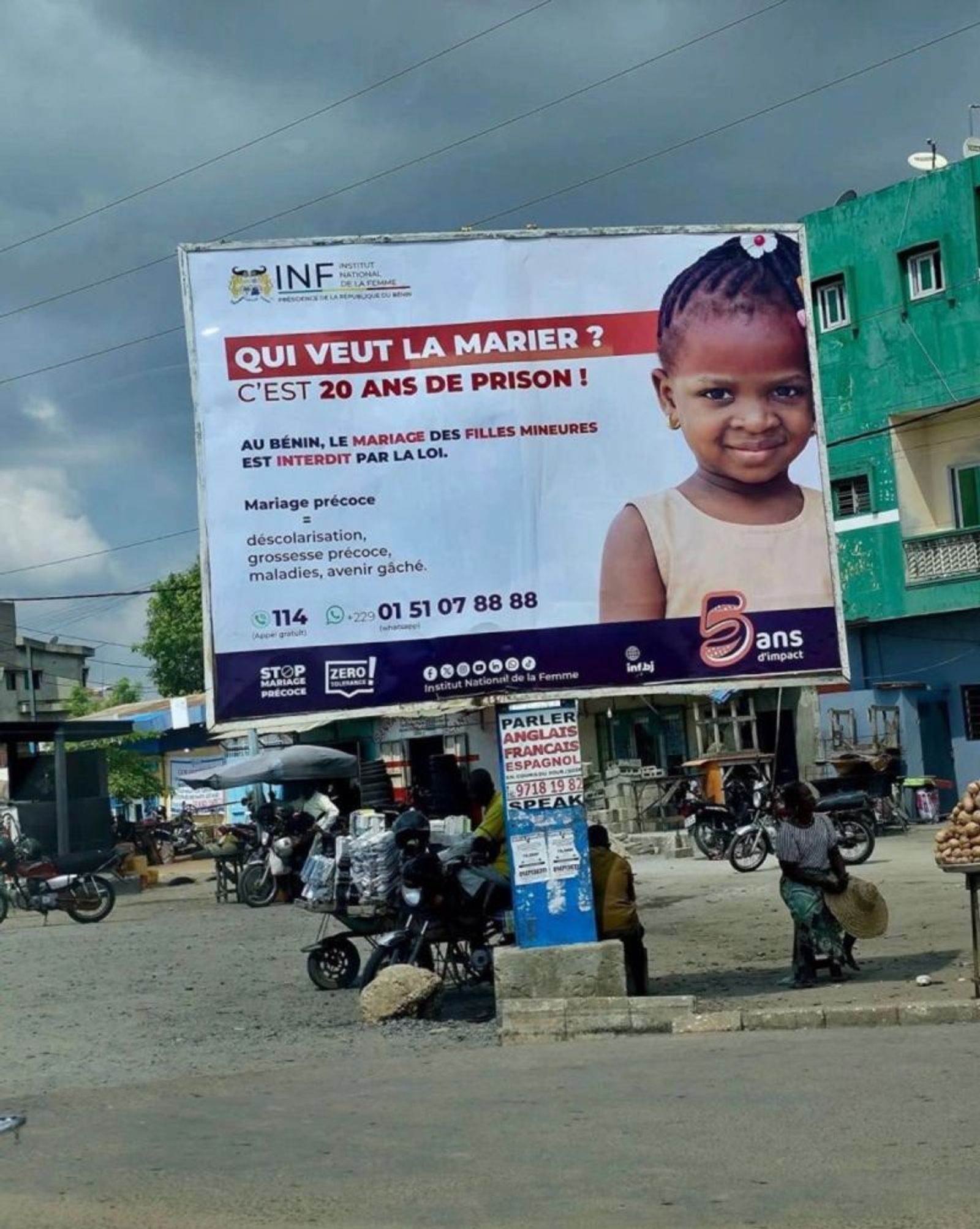
Benin’s child-marriage campaign confronts its audience
A provocative outdoor message places the responsibility for child marriage directly before the public, opening a debate on the role of shock in social advertising.

A billboard campaign in Benin has attracted attention with a blunt question: ‘Qui veut la marier ?’ (‘Who wants to marry her?’). The visual follows it with a warning of a 20-year prison sentence. The campaign, linked in public discussion to the Institut National de la Femme, takes a deliberately confrontational approach to the issue of child marriage. Its commissioning and creative credits have yet to be independently confirmed.
In a format where audiences may have only seconds to absorb a message, the campaign is striking. It addresses potential perpetrators and the adults who enable such marriages, rather than presenting the practice as an abstract social problem. Its direct language leaves little room for ambiguity about the behaviour being challenged.
When public-interest advertising needs to shock
Not every social campaign can rely on reassurance or an uplifting narrative. Advertising addressing abuse, road safety or other entrenched harmful practices has often used confrontation to interrupt familiar behaviour and make a difficult subject impossible to ignore. The creative decision to use a direct question and a stated consequence belongs to that tradition.
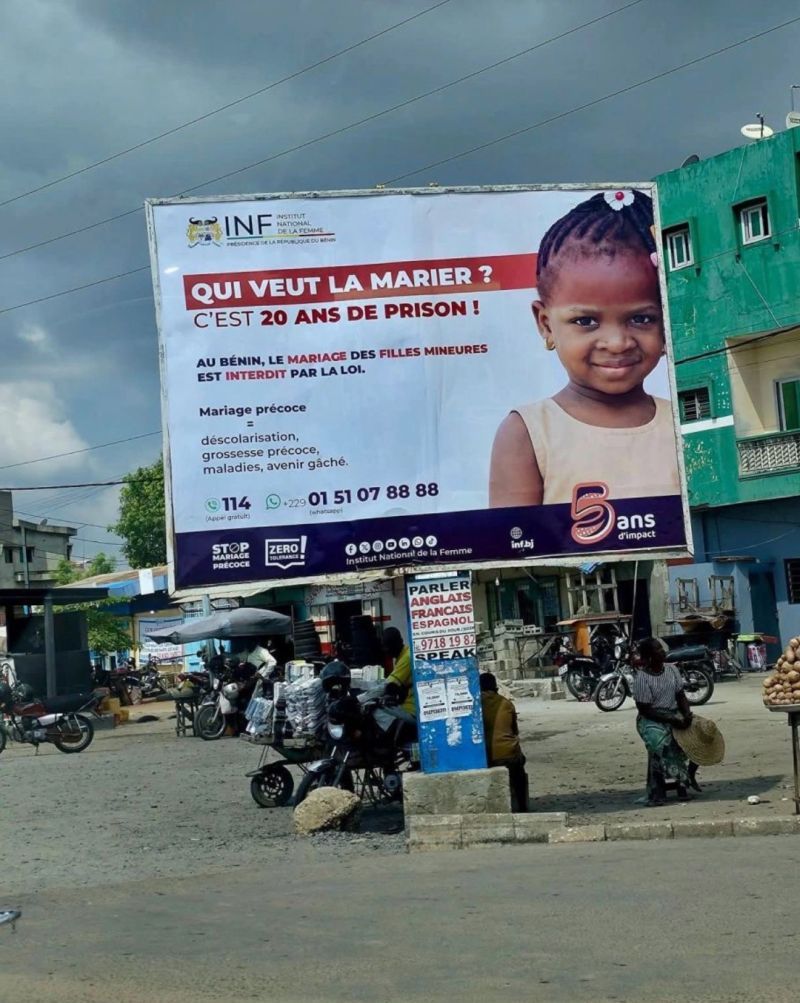
The Benin execution also raises a specific debate about the image used. In a commentary published on 20 November, writer Nounfoh Marthe Faré questioned the use of an identifiable child in an advertisement addressing exploitation and coercion, highlighting the potential long-term effects of circulating that image.
That criticism does not invalidate the campaign’s decision to confront the audience. It highlights the difference between the force of a message and the exposure of the person depicted in it. Child-protection guidance emphasises dignity, privacy and avoiding foreseeable harm in the use of children’s images. The original penalty claim also needs to be checked against the relevant legal text rather than repeated as a verified statement of law.
The force of the campaign lies in its direct address: it places responsibility on adults and invokes the consequences of their actions rather than appealing to sympathy alone. That is what makes the work interesting as public-interest advertising: it seeks to move a social issue from awareness to action. Brief54 is continuing to identify the agency and creative teams behind the campaign.
Sources :
Original campaign link supplied to editorial desk
Nounfoh Marthe Faré, published commentary, 20 Nov
UNICEF, guidance on safeguarding children in media